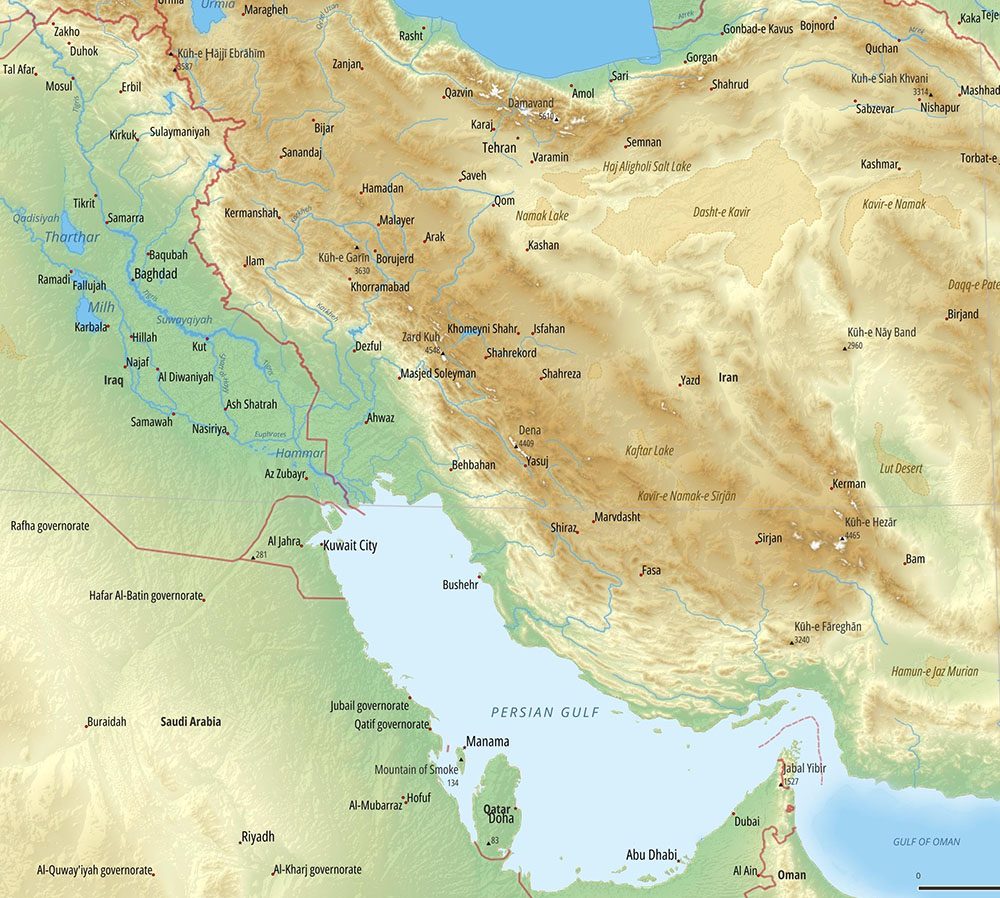
The U.S. and Israel conducted a joint-strike on Iran on Feb. 28, with the goal of precipitating regime change.
Within a few hours of the strikes, rumors of the death of Supreme Leader Ali Khamenei began to spread from within Iran before President Trump confirmed that he had been killed. The assassination of the Supreme Leader marked the first major action of the Iranian-American War and the first step into the Iranian catastrophe.
While initially supported by many Iranians alongside the international community in response to the Iranian massacres, public opinion, especially in America, has shifted.
The United States has conducted the largest military buildup up since the wars in Iraq and Afghanistan, contributing a significant amount of resources, manpower and money into this conflict. Trump initially claimed that the war would end quickly, stating to Republican Congressmen on March 10 that the war may be over ‘very quickly’.
However, this is clearly not the truth.
The war has been ongoing for nearly two months now, and from an analytical perspective, has turned into a war of attrition. In a war of attrition, the goal is not to rapidly defeat the enemy in direct battles, but gradually wear down the opponent’s economic, military and political capacity over time, until the other side gives up.
This is what the United States war in Iran has devolved into, and the United States isn’t winning it.
The war has caused an economic crisis—not only in the Middle East and the United States, but the world—and may lead to the worst for the United States.
The average American is already significantly impacted by this war, with gas prices across the United States averaging over $4.50 per gallon. For comparison, the national average before the war was $2.94. Inflation has risen as well, with economic theorists and analysts predicting the United States inflation rate will drive to 4.2%.
Worst of all, this economic crisis has occurred simultaneously with an internal crisis within the United States, as the partial government shutdown in April became the longest in United States history.
From a purely tactical and military perspective, the U.S. is winning the war, having inflicted devastating losses onto the Iranian military, and assassinating countless Iranian leaders, including the Ayatollah.
However, the Iranian strategy of a war of attrition has begun to take a significant and devastating toll on the United States economy and people. The U.S. is winning its battles, perhaps every single battle it takes, but whether it will win the war long-term as this war of attrition continues is far from clear.
Perhaps most disheartening, the United States and Israel have had multiple incidents where innocent Iranian civilians were killed in airstrikes and military incursions, including airstrikes on the civilian-populated Niloofar Square and a girls’ elementary school in Minab, killing 168 people, including over 100 children.
Even worse, our allies have begun to abandon the sinking ship.
President Trump, who’s had a history of terrible diplomatic relations with our traditional Western allies—ranging from outlandish insults to threatening to invade them—hasn’t made supporting the United States easy for our allies; and, with the war in Iran, he’s made it even harder.
Some of the president’s closest allies have begun to publicly criticise and call out President Trump’s war in Iran.
Italian Prime Minister Giorgia Meloni, who was once one of Trump’s closest associates, has publicly criticized the President and his war. Furthermore, the President has caused a rift between the Vatican and the United States by posting a ridiculous rant insulting and criticizing the Pope of the Catholic Church.
What is clear, though, is that the United States’ people are done with the war and public support for the war in Iran has dropped.
According to a poll by Pew Research Center, 61% of the American population disapproves of the war, compared to 37% in support of the conflict.
Meanwhile public opinion on Trump’s term has also plummetted from a baseline 47% approval to 36% approval. Due in part to his criticism and insults levied against the Pope, American-Catholics, who voted overwhelmingly for Trump in 2024, have begun to defect.
BHS students also seem largely opposed to the war.
“Personally, our government should focus on domestic issues, such as social services and income disparity,” junior Sam Park said.
“The war in Iran seems pointless. War in general seems pointless, and I’d rather have peace in the world than conflict,” junior Collin Tew said.
“Fighting a conflict on a larger scale is not worth it, our economy is going down and our gas prices are going up,” junior Daniel Chen said.
The intervention on behalf of the Iranian people was justified in order to end the regime’s earlier massacre of protestors in January, when the Iranian government conducted internet blackouts and firing live ammunition against demonstrators.
However, does it justify continuing the war for another two months? I, and countless other Americans here and across the country, disagree.
The war has caused detrimental economic losses and suffering to the people of the United States. Gas prices have risen astronomically as a result of the closing of the Strait of Hormuz.
While the U.S. military casualties continue to increase, innocent civilian lives in Iran are ended by American bombs and aircraft and our allied nations across the Middle East continue to suffer from retaliatory strikes by Iran.
Trump constantly used the excuse that this was a support operation for the Iranian people to rise up against Khamenei. However, it has become clear that no sort of revolution will occur within Iran, and this should have been the stopping point to discuss a peace deal with the Iranian regime.
Otherwise, to consider a land-campaign in Iran similar to our ground invasions of other Middle Eastern countries would be disastrous. Historians, political analysts, and military experts unanimously agree that a ground invasion of Iran would spell disaster and worsen our dire economic situation.
While I am confident the United States will achieve its military objectives despite heavy losses, significant resource loss and the sacrifice of the world economy and our own, I am not confident that we will be able to uphold Trump’s objective of a regime change and long term peace in Iran.
The United States’ track record of nation building in the Middle East has been abysmal—look at Iraq and Afghanistan in the aftermath of our wars.
The war in Iran has brought us disastrous economic loss and Trump jingoism may spell disaster for the United States global position.