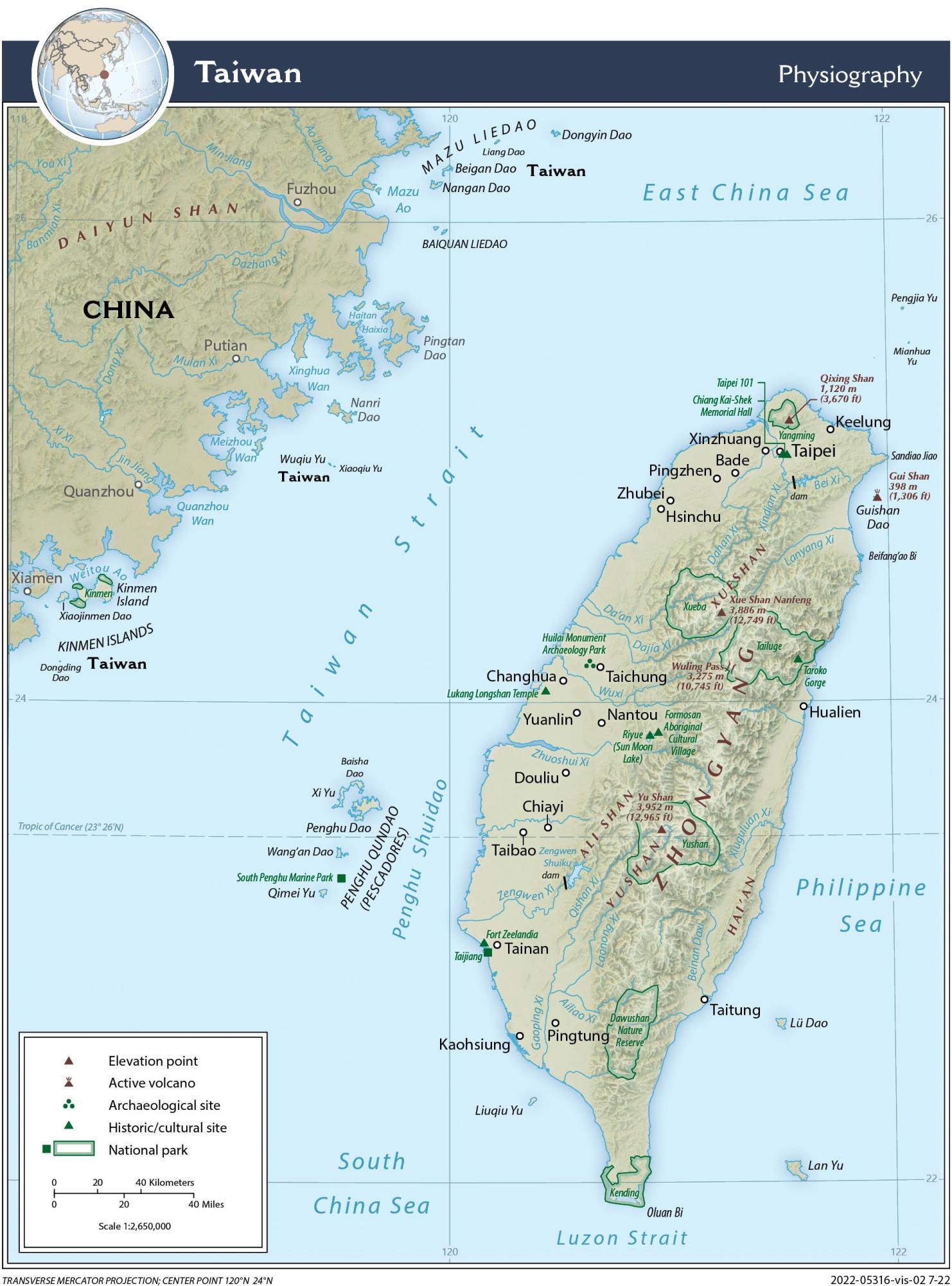
Among the United States allies, only a few of them have been given such special priority to have an entire fleet dedicated to their protection. One such ally is the nation of Taiwan, formally the Republic of China.
However, despite the United States having come to the defense of Taiwan on multiple occasions through the use of the Seventh Fleet, and every president since Truman advocating for the defense of Taiwan, the United States doesn’t recognize Taiwan as a sovereign nation.
In fact, there are only 12 countries that currently do, a fact that is troubling to many Taiwanese people.
“I hope people outside of Taiwan understand that this country – Taiwan is a vibrant and a democratic society with its own identity and voice,” said Chinese teacher Ai-Lan Lin, who is originally from Taiwan. “People who are from Taiwan, whether they remain or go overseas, care deeply about freedom and the ability to decide our own fate.”
To understand why the United States has pledged to defend Taiwan yet refuses to recognize its sovereignty you’d have to go back to the Chinese Civil War.
Erupting in the early 1920s and eventually erupting once more in the late 1940’s, the Chinese Civil War was fought between the Chinese Communist Party (CCP) under the leadership of Chairman Mao, and the Kuomintang (KMT) under the leadership of Chiang Kai-shek.
While most international observers believed the KMT would easily win the war, as it had a large modernized army with aircraft and motorized vehicles, the CCP triumphed.
Despite the KMT initially winning in the early 1920’s and in the early stages of the second phase, the CCP, and now the People’s Republic of China (PRC) defeated the KMT.
However, while the KMT was defeated on the mainland, they weren’t finished fighting. Chiang Kai-Shek ordered a retreat to the island of Taiwan, where the Republic of China would continue to exist. This led to the beginning of the Strait Crisis, as both China and Taiwan claimed to be the legal and legitimate Chinese Government.
For decades, the international community and the United States recognized the Republic of China (Taiwan) as the legitimate government of China.
However, this opinion would shift in the 1970s amidst the aftermath of the Sino-Soviet split, as the United States and a multitude of other Western nations reopened diplomatic ties with China. Inevitably, the United States, alongside many other nations, began to recognize the economic and trade potential of China.
The warming relationship with mainland China culminated on Jan. 1, 1979, when the United States recognized the People’s Republic of China as the sole and legitimate government of China.
Taiwan was removed from both the United Nations and the United Nations Security Council and was replaced with the PRC.
So why does the United States continue to insist on the existence and protection of Taiwan, despite abandoning them in favor of the PRC?
Geography. And semiconductors.
The greatest threat to the United States’ strategic position in the Pacific is the PRC, regardless of an improvement in relations during the 80’s. To concede and allow China to secure total control over the island of Taiwan would be a massive strategic loss for the United States.
Having military influence over Taiwan’s waters allows an essential encirclement of Chinese territorial waters, with South Korea, Japan and Taiwan acting as a blockade. Furthermore, Taiwan is a massive economic powerhouse in Asia and one of the largest producers in semiconductors.
Apart from the select ‘Four Asian Tigers’, Taiwan is one of the wealthiest and most well-developed nations in the world, and to cede control over the country to China would bring companies such as Taiwan Semiconductors under the control of the CCP.
Without a doubt, Taiwan is an extremely valuable asset for the United States strategically, and likely the main reason for the United States’ defense of the country. However, it isn’t the only reason. Ever since Wilson’s 14 points in the aftermath of World War I and the formation of the United Nations, self-determination has always been a value to fight for. And the Taiwanese people want freedom.
They want self-determination and ferociously refuse to submit to the People’s Republic of China and the Chinese Communist Party. They’ve seen what happened to Hong Kong and Macau: the brutal CCP crackdown on Hong Kong protestors. The liberty and democracy of the Taiwanese people will be put at risk should the world turn its back on Taiwan.
Chinese teacher Lin explained the values of Taiwanese society.
“Taiwan is a vibrant and democratic society with its own identity and voice,” she said.
Junior Nick Cheng, whose father is Taiwanese, also emphasized the importance of democracy and freedom for the Taiwanese people.
“I identify as Taiwanese in my daily life,” Cheng said. “I see Taiwan as an independent country.”
“I think having free thought and being able to question things is important,” he added.
Just as Hong Kong had valued its democracy, the Taiwanese people hold democracy as a core value of their Republic.
And considering China’s history of oppression and resistance to democratic reforms, as exhibited in the 1989 Tiananmen Square massacre, in which the Chinese Government used military force to violently put down a democratic student assembly, leading to the death of up to 700 students, the threat of Taiwan’s democratic institutions being stripped by China, should Taiwan ever fall, is certainly real.
Cheng is saddened by the stakes of the conflict for the island, which is about the size of the state of Maryland and faces an antagonist with a population roughly 60 times larger.
“It’s a little sad to watch, but there’s not much that can be done,” Cheng said. “Realistically, Taiwan is kind of outmatched, so it’s hard to feel hopeful.”
Lin has a broader view of the source of the conflict.
“[The conflict] is largely about different political systems and different views about sovereignty and identity,” she said.
However, there is always hope in this world. Just as the United States defended Korean democracy against the aggression of the Democratic People’s Republic of Korea, the United States should do the same for Taiwan.
The Taiwanese people want their freedom, and they want their country. The defense of Taiwan is not just for strategic reasons, but the defense of 23 million voices that call for democracy and self-determination.
“Any long-term solution should respect the wishes and well-being of the people who live in Taiwan,” Lin said.
So while Taiwan may remain unrecognized, it is still our ally, and its freedom is worth defending.