
April was a challenging month for BHS students, as we had to adjust to several different schedules for Ohio’s End-of-Course (EOC) exams.
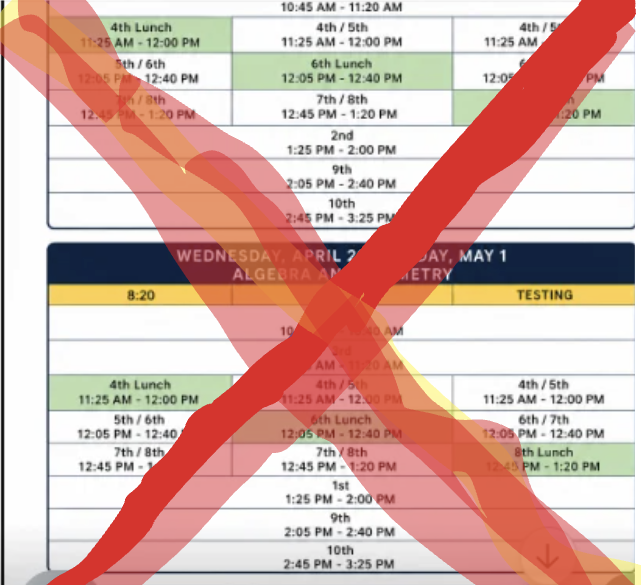
These tests began with English 2 on April 14 and 15. Then students took U.S. history and government 1 and 2 exams on April 20 and April 21. This same week, biology students took their EOC on April 23 and April 24. Algebra and geometry students took their tests April 29 and May 1.
Although the schedules varied depending on the day and exams taken, classes on a testing day started either at 10:05 or 10:40 following the tests. Students who did not have an exam were permitted to come in later.
On the other hand, EOC schedules ended at 3:25, later than the typical end of the school day at 2:56.
Also, on some days the order of the periods changed, which some students and teachers found confusing.
English teacher Dr. Casey Matthews explained that creating an EOC schedule is not easy because it must meet the needs of many different teachers and students.
Administrators asked for teacher input, but that doesn’t mean that everyone was happy.
“It’s hard schedule to meet the needs of [everyone],” Matthews said. “No matter what, something has to give.”
According to Matthews, one goal behind designing the schedule was so that some teachers could see their students every day as they prepared for the tests.
“I think the goal was to give as much time as possible to the students with their math teachers,” she explained.
Before the final schedule was chosen, several other ideas were considered.
“There were some where we would do half of the schedule one day and then the other half,” she said.
However, she explained that those options created issues for certain classes, including Excel TECC students. She also mentioned that consistency was also an important factor.
“I wish it were more consistent, because [it makes it easier for teachers to plan,]” she said.
As an English teacher, Matthews believes there is no perfect solution to EOC scheduling.
“There is no option that’s going to work for everyone and meet the needs of every student,” she said.
Matthews explained that the decision to extend the school day by half an hour on some days may have been connected to teacher contracts and instructional time requirements.
“Part of it is contract time and we have to have so many minutes every day,” she said. “Especially for teachers, they have to be here for 7.5 hours.”
Students and staff have had mixed reactions about the EOC schedule.
There were some benefits that students appreciated. Senior Jaylah Wise enjoyed being able to sleep in later, since she did not have to arrive at school until 10:00 or 10:40 during testing.
Junior Tahlia Horne appreciated how the classes were shortened, making the day feel a bit less overwhelming.
Like many students, Wise found the different schedules hard to follow.
“The schedule changes were confusing,” she said.
On the other hand, Horne said she no longer found it confusing once she got used to the routine.
Wise explained the schedule she would prefer to see. .
“They should make the day shorter,” Wise said. “We should make the schedule for you to come in at 10:40 and leave at regular dismissal.”
Horne agreed.
Overall, the EOC schedule offers some clear advantages, such as later start times and shorter classes, but it also presents challenges like long days and post-test classes.
Even with the challenges, Matthews emphasized that the testing season is challenging for students and staff.
“It’s stressful for everyone,” she said.
Matthews believes students and teachers may see this schedule again next year.
However, administrators should listen to student and teacher feedback to create a more balanced schedule.