


For 11 years, Irit Oberster’s Hebrew classroom has been a space defined by cultural connection, where students build sukkahs, bury time capsules, and taste traditional foods.
“It’s fun. I mean, it’s learning—It’s not fooling around,” Oberster said. “But it’s also combined with a lot of fun with all the holidays that we do and we built a sukkah over here.”
Established in the 70s as one of the only Ohio public school Hebrew programs, it serves as a unique opportunity for Beachwood students to connect to Jewish culture.
But last year, that community was turned on its head.
As part of a broad restructuring of foreign language programs throughout the district in the 2024-25 academic year, individual higher-level language classes in the high school (Hebrew 4/5 and Honors 4/AP Chinese) were combined into single periods.
Tasked with teaching two completely different classes simultaneously, Oberster found herself constantly circling around the room, attempting to deliver two distinct lessons to two different groups of students at once.
The veteran teacher admits the toll that the logistical juggling of combined periods took on students and staff.
“Putting all these students together really caused my first year [teaching combined 4/5 Hebrew] to be extremely stressful … very stressful,” Oberster said. “At least for the kids, they did not get my full attention.”
Oberster noted she was only able to teach half the content of Hebrew 4 and Hebrew 5 last year. The constraints of combined periods left students unprepared for higher level Hebrew classes.
Annabelle Shapiro, a senior who took Hebrew 5 last year, describes how combined periods put students and teachers in an impossible situation, harming the students who choose to continue with the language.
“Mrs. Oberster didn’t really have time to teach us, because she was dealing with the crazy kids in the other class. So we had to kind of teach it to ourselves,” Shapiro said. “And then this year, I’m in Hebrew 6 with all of these Hebrew 7 kids who are almost all Israeli. And I can’t keep up at all.”
Oberster and Shapiro’s struggles highlight a growing challenge in Beachwood’s foreign language department, where staffing decisions and administrative goals force teachers and students in Hebrew and Chinese to grapple with the effects of combined periods.
In the restructuring, the administration added exploratory foreign language programs for Chinese and Spanish in the elementary schools, but the change excluded Hebrew.
Director of Curriculum & Instruction Dr. Linda LoGalbo explains that the district chose to not include these programs because the majority of students who choose to enroll in Hebrew already have a background learning Hebrew through Jewish day schools or Sunday school programs.
“Very few students—I’m talking on one hand—who don’t have a background in Hebrew actually take Hebrew as a language,” LoGalbo said. “And so we didn’t need to provide an exploratory for that, whereas our population in terms of learning Chinese and Spanish, we have non-native speakers.”
Oberster has expressed concerns over this exclusion’s implications on the future cultural diversity of the Hebrew program.
“They do introduction programs for Chinese and Spanish in the elementary school. But not Hebrew. They’re building up that program where my program can suffer over time,” Oberster said. “If they don’t offer [elementary school Hebrew], then maybe I’ll just get like the Jewish kids. But I want more than that, you know? I like to teach everybody.”
To teach the new elementary school classes, the district only hired a new teacher for the Spanish program. Opting to put the increased Chinese course load on the district’s current two Chinese teachers, the district changed both teachers schedules to travel between two or more schools to teach classes at all age levels.
In order to fit all of these classes into the teachers’ work schedule, the district combined the two highest levels of Chinese into a “combined zero period,” where Honors 4/AP Chinese students need to wake up early and arrive at the school at 7:30 AM for their combined class.
The reason why the district combined the Hebrew 4 and 5 was different. The middle school Hebrew teacher Sonia Youngster retired the year prior, and the district ended up not hiring a replacement teacher.
Instead, the district combined Oberster’s high school classes in order to free up enough time in her schedule to travel and teach the middle school classes.
LoGalbo states that one factor that the district considers when evaluating the necessity of hiring new teachers is the number of students enrolled in the language program.
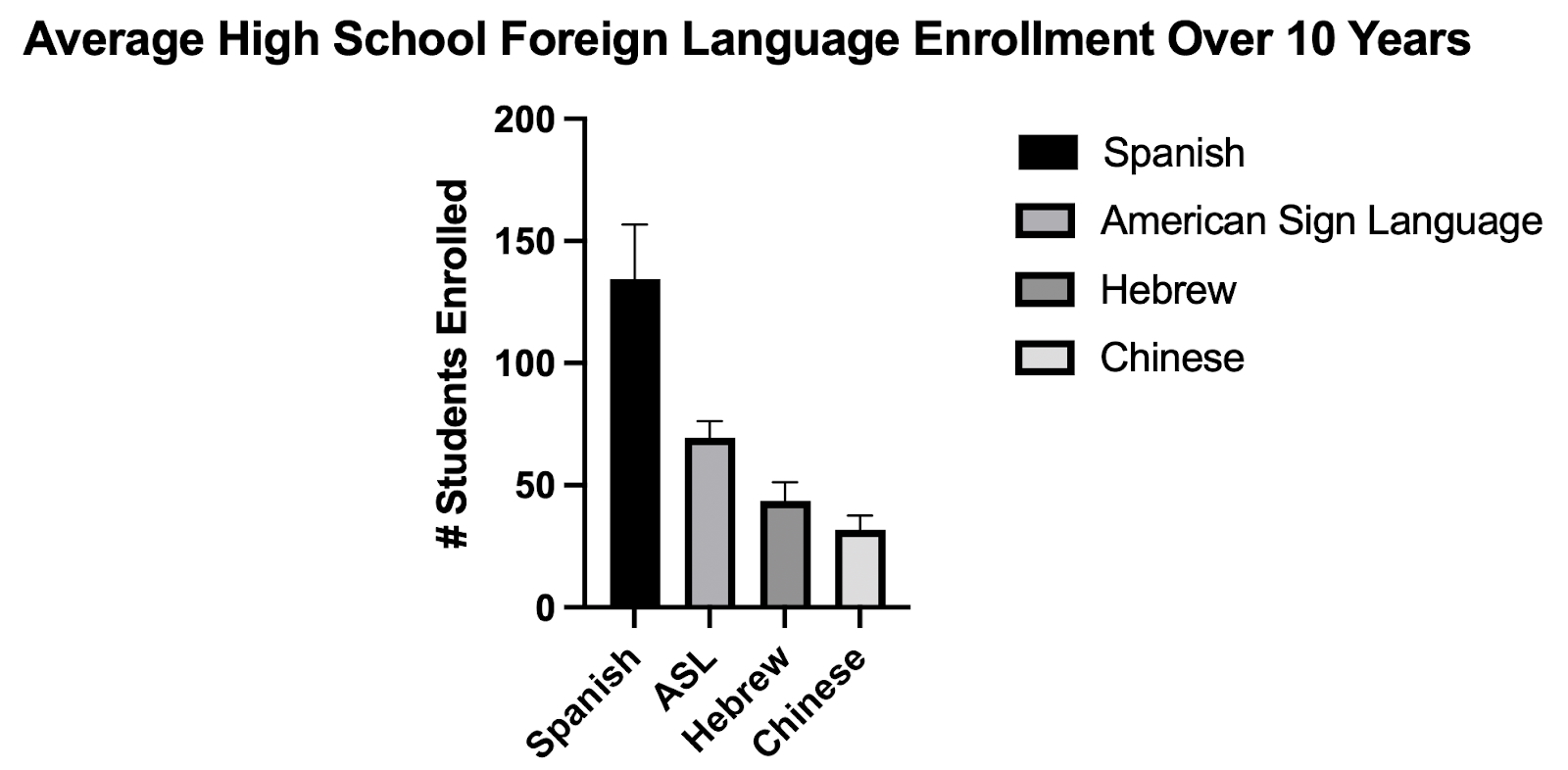
“When we staff, we look at enrollment numbers,” she said. “When any teacher retires, we say, okay, do we need this position? What does it need to look like?”
Enrollment is often low in the higher level language classes, which played a significant role in the district’s decision to combine classes.
As teachers and students deal with the effects of combined periods, the combined Honors 4/AP Chinese teacher Ai-Lan Lin proposed a solution using College Credit Plus classes that could solve the problem of combined periods and may help boost enrollment, though it comes with its own risks.
This solution, initially proposed to replace combined Honors 4/AP Chinese, would involve the district partnering with a neighboring college to offer CCP Chinese 1 and 2, each taught as a single semester class at BHS.
Depending on the college, this arrangement could give twice the amount of college credit compared to the AP exam, as well as replace the 4.5 weighted GPA Honors 4 Chinese class with a 5.0 weighted GPA CCP Chinese 1 class.
In addition, CCP classes allow students to receive a full year’s credit of foreign language in just one semester, allowing students to accelerate their studies and teachers to separate their once combined classes.
“The idea behind [CCP classes] is if we could condense classes to a semester and do the college model, we might not have to combine,” LoGalbo said.
The curriculum of CCP classes would be different from the current Honors 4 and AP Chinese classes and would not teach elements of Chinese culture tested on the AP Chinese exam. Students interested in taking the AP Chinese exam would need to self study with materials that Lin provides.
Students have expressed support for this change being explored in the Hebrew programs as well.
“Yeah, I would probably [take CCP Hebrew] with the weighted GPA, and to be able to get [Mrs. Oberster’s] undivided attention for just that class would definitely be helpful,” Shapiro said. ”So I feel like if I got that attention, I would be able to take that college class.”
There is currently no AP Hebrew exam and therefore the Hebrew program currently doesn’t have a 5.0 weighted GPA class. CCP Hebrew would give students the opportunity to take classes that provide them college credit and a weighted GPA.
However, since CCP classes are college level classes taught in a single semester they may be faster paced than the current Chinese and Hebrew curricula.
There is also a potential for financial liability for parents if students do not pass CCP classes, with exclusions for the economically disadvantaged.
According to the Ohio College Credit Plus FAQs, “If you do not receive a passing grade, the district may, in some instances, seek reimbursement from [families] for state funds paid to the college on your behalf for that college course.”
CCP classes offer a potential solution to combined periods while incentivizing enrollment in higher-level Hebrew and Chinese through GPA boosts and college credit. However, the district must be cautious to ensure students are fully prepared to take college level courses.
But with the current detrimental effects of combined classes on teachers and students alike, Beachwood should seriously consider exploring these CCP classes.