
During my trip to Boston this summer, aside from exploring the city’s incredible landmarks, I examined the area through the same lens I had used in Cleveland: tracing the opioid epidemic through access to naloxone and public awareness.
Naloxone is a medication that can reverse the effects of an opioid overdose by restoring normal breathing to a person who has overdosed.
I recorded naloxone accessibility as part of an initiative called the Naloxone Accessibility Challenge coordinated by SAFE Project, a nonprofit focused on ending the addiction fatality epidemic.
Visiting pharmacies like CVS and Walgreens, I took note of where naloxone was displayed, how easily it could be found, its cost and whether signage or other informational materials about overdose prevention were visible.
But pharmacy access was only one part of the story. I had heard about naloxone vending machines and public installations and wanted to understand how the city was making overdose reversal medication available beyond the counter.
As I researched policies and public health data, I expected numbers, reports and prevention strategies. Instead, I found a personal connection that reshaped my perspective.
I discovered that one of the people behind one of the city’s most visible harm-reduction efforts, the naloxone boxes now installed across Metro Boston Transit Authority (MBTA) subway stations, once walked the same BHS hallways I do.
While researching Harvard College Overdose Prevention and Education Students (HCOPES) and their pilot program to install naloxone across the MBTA Red Line stations, I learned that one of the co-founders of the organization was Swathi Srinivasan, a BHS alumna.
Srinivasan graduated from BHS in 2017, from Harvard University in 2021 and is currently pursuing a PhD in Population Health Sciences at Harvard.
I also found a Beachcomber article from 2021 had covered her achievement as a Rhodes Scholar.
I was excited to learn that a former BHS student helped lead a crucial harm-reduction initiative I consider crucial based on my research on naloxone and the importance of access.
I wanted to learn more about HCOPES and the MBTA Red Line pilot program, and I was able to do so by speaking with Srinivasan.
Her story, I learned, was not about passing a bill or simply installing boxes. It was about overcoming grief, frustration and what happens when students refuse to accept silence.
When Srinivasan first began working in overdose prevention, Boston’s crisis was already escalating.
“Boston was in an interesting spot because the fentanyl crisis had already begun, but we were starting to see it ramp [up further],” she said.
She mentioned how the COVID-19 pandemic exacerbated the crisis as well.
“Back then, COVID had not happened yet, but when it came, it dramatically impacted the overdose crisis because of isolation and people’s access to healthcare,” she said.
At the time, outreach organizations and clinics were already doing life-saving work.
Srinivasan shared where these efforts were concentrated and what programs were held in support of them.
“There were some incredible efforts happening in places like Mass and Cass (an intersection between Massachusetts Avenue and Melnea Cass Boulevard), which have a high density of people who use drugs. Clinics like Boston Healthcare for the Homeless Program, programs like AHOPE, the syringe service program, were doing amazing work and continue to do so,” she said.
Srinivasan emphasized that HCOPES’s work was grounded in a broader understanding of addiction as a structural public health issue.
“Our work was influenced by rising numbers of overdose-related fatalities among people with and without substance use disorders, in particular due to the toxic drug crisis,” she said. “Substance use disorder is a very complicated public health issue related to a lot of things: access to mental health care, childhood development and housing.”
She also noted that overdose is not only a medical issue but a political and social consequence of policy choices and social stigma.
“Overdose in particular is a consequence of a very toxic drug epidemic due to the way that we have criminalized certain drugs, criminalized certain people and changed drug markets,” she said.
This perspective was formally recognized in 2021, when Boston declared addiction a public health crisis, signaling a shift toward treating substance use through a public health lens rather than primarily through punishment.
For Srinivasan, however, the crisis became impossible to ignore after a fatal overdose occurred on Harvard’s campus. The person was not affiliated with the university, but that fact did nothing to lessen the weight of the moment.
“That person was 26 years old,” she said. “They were not a member of the Harvard community, so no one on campus talked about it. But that does not mean that they did not matter. Their life mattered.”
She elaborated on HCOPES’s push to raise awareness about overdose fatalities within the larger community.
“We wanted to recognize that Harvard is part of a bigger community: Cambridge, greater Boston and Massachusetts,” she said. “We’re not immune to this. And overdoses happen on campuses, in dorm rooms. I know that for a fact.”
Srinivasan noted that many people often hold a narrow image of who overdoses, picturing unhoused individuals or people injecting drugs. While substance use is more common among unhoused populations who face higher rates of mental illness, overdoses also happen quietly inside homes and private spaces.
With today’s increasingly toxic drug supply, overdose risk extends beyond opioids alone, as drugs like cocaine are now more likely to be laced with fentanyl. “It truly can be anyone,” Srinivasan said.
Srinivasan explained how the overdose fatality on campus influenced the organization’s work in advocating for naloxone access.
“We pushed to improve naloxone availability because if naloxone had been available, maybe that person wouldn’t have died,” she said. “It wasn’t a cerebral decision. We saw what was happening, and we responded.”
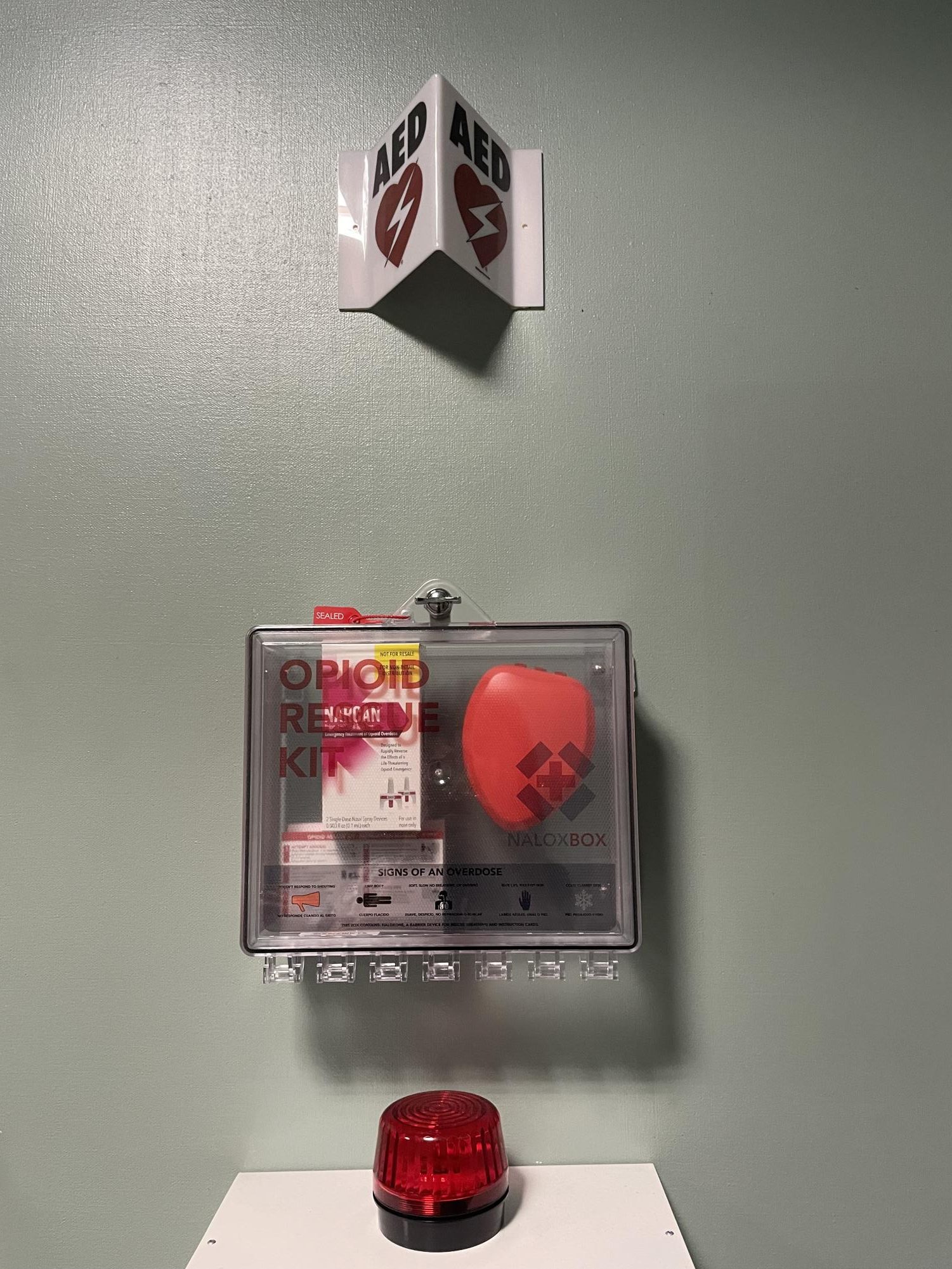
At the time, HCOPES was working to expand naloxone access on campus, and one of their proposals was to place naloxone kits inside AED cabinets.
The proposal was detailed and researched. Despite this, it was ultimately denied, and the team had to figure out another plan.
“We met resistance at the highest level of administration and health services,” she said. “We were pretty bummed. We had done research, gathered support and reached out to organizations nationwide. But when the proposal was ultimately rejected, we refused to give up.”
The students decided to look elsewhere, and after much thought, they decided to go broader: to the city and the state.
The shift redirected the project’s focus.
When Srinivasan graduated, HCOPES students obtained overdose data from the Cambridge Health Department and looked at heat maps to identify where overdoses were happening most often.
Subway stations, it turned out, were more than transportation hubs.
As Srinivasan explained, the results were not entirely surprising to those familiar with the area.
“Those of us who live in Cambridge could have probably guessed that these would be hotspots. We see what goes on around those areas and it makes sense,” she said.
What stood out, however, was the scale of the problem.
“It was kind of shocking compared to other parts of the city,” she said. “It’s not just one or two [overdoses]. It’s several in some of these places.”
When I asked Srinivasan to describe the early planning stages of the initiative, she explained how the project gradually took form through the work of two students, Sajeev S. Kohli and Jay P. Garg.
By the time she transitioned from HCOPES to pursue her Master’s degree, Srinivasan explained that HCOPES and the project were in great hands, and the team began reaching out to others to build momentum.
She stated that the students had moved into what she described as a process of “surveying all of these different programs [initiatives aiming to make naloxone more accessible] on how they made it happen: what did they do, what were their costs, how have they managed to continue it, what does sustainability look like, and who maintains these projects?”
Logistical decisions quickly became central to the project. As Srinivasan said, the team questioned details that would determine the program’s success: “Should it be a box on the wall? Should this box be alarmed or not alarmed? How often should the naloxone be replaced?”
Over time, the project matured into a formal proposal. “Over the course of two years,” Srinivasan said, “HCOPES put together this proposal through interviews and conversations with people.”
The students then circulated the proposal widely for feedback.
Eventually, their efforts gained the attention and backing of State Senator John Keenan and Chief of Staff Mark Sternman, both of whom became strong supporters of the initiative and helped move actions forward at the legislative level.
“They [Senator and Chief of Staff] helped move the project into the state budget as an amendment. Instead of passing a bill, it became a financial action,” she said. “The state allocated $95,000 to implement naloxone stations not just in some places, but on the entire Red Line.”
But for the team, funding marked a beginning rather than an ending.
“When it first passed, we all felt a huge moment of relief,” Srivinisan said. “We were overjoyed, but at the same time, we realized that this was just the beginning.”
The team partnered with the transit authority and worked to shape the project from a proposal into a working system. “The MBTA is really leading the project implementation,” Srinivasan said.
She mentioned how the team constantly questions the implementation of the project and its impacts. “Is it working? What does working mean?” she stated. “Does it mean fewer overdose deaths? Is it being used in emergency situations? All of these are the questions we have and continue to ask.”
Yet the boxes did not arrive without criticism. Some people raised concerns about “moral hazard”: the idea that naloxone enables drug use. Srinivasan rejected the argument directly. “That’s been disproven again and again,” she said. “Naloxone does not cause drug use. It reduces death.”
She compared naloxone to routine safety equipment. “We don’t think AEDs will cause more people to have heart attacks,” she said. “And we don’t think insulin will cause more people to develop diabetes.”
Despite national recognition, including acknowledgment from the White House, many commuters may still pass the boxes without knowing what they contain or why they exist. Even more troubling is that overdoses often go unrecognized. Srinivasan emphasized that education, not just access, remains the missing piece.
“People may think someone on the street is just sleeping,” Srinivasan said. “But if they’re not responding, if their lips or fingertips begin to turn blue, if they feel cold, or if their skin starts to look pale or chalky, these are all signs of overdose that I wish people knew to recognize.”
She argued that awareness and training matter just as much as availability. “I’m teaching people that this is a skill that should be taught like CPR,” she said. “It might not be something that you’ve seen or been able to recognize before, but it doesn’t mean it’s not happening. There should be no stigma attached to that.”
Nationally, there is evidence that harm-reduction efforts are making a difference. Data from the Centers of Disease Control and Prevention shows nearly a 24% decline in U.S. drug overdose deaths over the past year, the largest single-year decrease recorded.
However, Srinivasan stressed that progress has not been equal. While overall overdose deaths have declined, disparities persist and in some cases have worsened. In Cuyahoga County, overdose deaths among Black residents rose from 42% to 48% in the first half of 2025, even as deaths among white residents declined, highlighting the need for better interventions.
There are no dangers to administering naloxone to a person who is not overdosing. According to FDA (U.S. Food and Drug Administration), if opioids are not present, naloxone has no effect and causes no harm.
Srinivasan explained that naloxone was not widely available in Boston’s transit stations.
“The T never officially had naloxone in stations before,” she said. “Certain officers carried it, but if there was no officer nearby, there was nothing someone could do.” Before this initiative, “not a single MBTA station had naloxone.”
While Massachusetts distributes naloxone widely, Srinivasan pointed out that access still breaks down when systems fail.
“We gave out naloxone,” she said of her work in a health care center for the homeless. “But when clinics close, who’s distributing it?”
She also described the unrealized potential of vending machines that the city purchased but never fully installed.
“People still can’t always reach what they need when they need it,” she said.
Many overdoses, she noted, do not immediately receive emergency response.
“In settings like encampments, peers are often the first responders,” she said. “It’s not the police that come first, it’s not even the EMT that comes first, it’s the person standing with that person that pulls naloxone out of their bag and utilizes it and can recognize the need and respond to it.”
That reality, she argued, demands greater support for community responders, particularly unhoused individuals who face the highest risks.
Srinivasan’s work has always been personal. Growing up in northeast Ohio, she saw substance use disorder and overdose treated as something to hide.
“Overdose is a very difficult thing to talk about in Ohio,” she said. “But we know it happens here. We’ve seen it. People have died in their homes and behind closed doors.”
Srinivasan added that there are robust programs in the area.
“There are incredible programs that exist in Ohio, but because it’s such a big state, it’s hard to have these conversations together. There’s also less funding being allocated to harm reduction than in other states.”
Boston, by contrast, she explained, has a different culture of conversation.
“When I got to Boston, there were more people having this conversation because it’s a big city in a small state,” she said. “I found people in college and in different community spaces who had similar experiences to me and who were willing to chat.”
HCOPES itself began with conversation.
“We started by just talking,” she said. “We talked about what we’ve been through, what our communities have been through, and what’s happening around us. Things that nobody wants to talk about.”
From that, the organization grew, built around three arms: a policy arm, an education arm, and a community advocacy arm. The policy team would eventually lead the transit initiative.
The community advocacy arm focused on public engagement and training.
“Our community advocacy arm was working with local businesses to train them to use naloxone, training local students,” she said.
The group also spotlighted art as a form of activism.
“We held a local artist who did protest-related art on the overdose response,” Srinivasan said.
Education formed another foundation for the organization’s work. Srinivasan explained how the education arm involved local education, shadowing people who do substance-use-disorder-related medicine, and shadowing street doctors.
Students also volunteered in programs such as Camp Mariposa, “where kids whose parents and family members have been impacted by overdose have a space to be… like Camp Kesem (a national organization) for kids impacted by cancer,” she said.
The camp, she added, is part of the Eluna Network and supports children affected by the overdose crisis.
For Srinivasan, covering “several bases” was essential. HCOPES was designed so that every student had a role.
“We had students who were interested in all these different things, but there was a place for them,” she said. “Whether they wanted to be an advocate, or a policymaker, or just a mentor, a teacher, a friend—all of that was necessary.”
At first, their focus was campus safety.
“We wanted naloxone in AED boxes on campus,” she said. “But then we realized we’re part of a bigger community. We realized that we should be owning up to our membership of not just the Harvard community, but also as citizens of the Cambridge community, and that our work should reach everybody in this community that we’re a part of.”
The work of HCOPES is just one of many harm reduction initiatives addressing the opioid epidemic, but as Srinivasan emphasized, expanding public understanding of what naloxone is and how it is used remains essential to reducing stigma and promoting response. It is work she hopes to promote throughout Ohio.
“Ohio is my home, it is where my interest in this work began. I’ve never forgotten that,” she said.