
In 1915, over 1,500,000 Armenians were slaughtered in the Armenian Genocide, perpetrated by the Ottoman Empire during World War 1.
Thousands were forced to flee from their ancestral homes in Western Armenia, while Ottoman soldiers sacked and slaughtered Armenian villages daily.
The international community did nothing to stop it.
Just before invading Poland and dragging Europe into World War II, Adolf Hitler referenced the world’s indifference to Armenian deaths in his own calculation to invade Poland and treat the Polish people with shameless brutality.
“After all, who remembers today the extermination of the Armenians?” Hitler asked.
By 1923, over 90 percent of Armenians had disappeared from their ancestral homeland. Most of those who had not been killed were deported or fled.
By 1930, more than 125,000 Armenians had immigrated to the United States, according to the Armenian Immigration Project, and today there are thousands of Armenians in the Cleveland area.
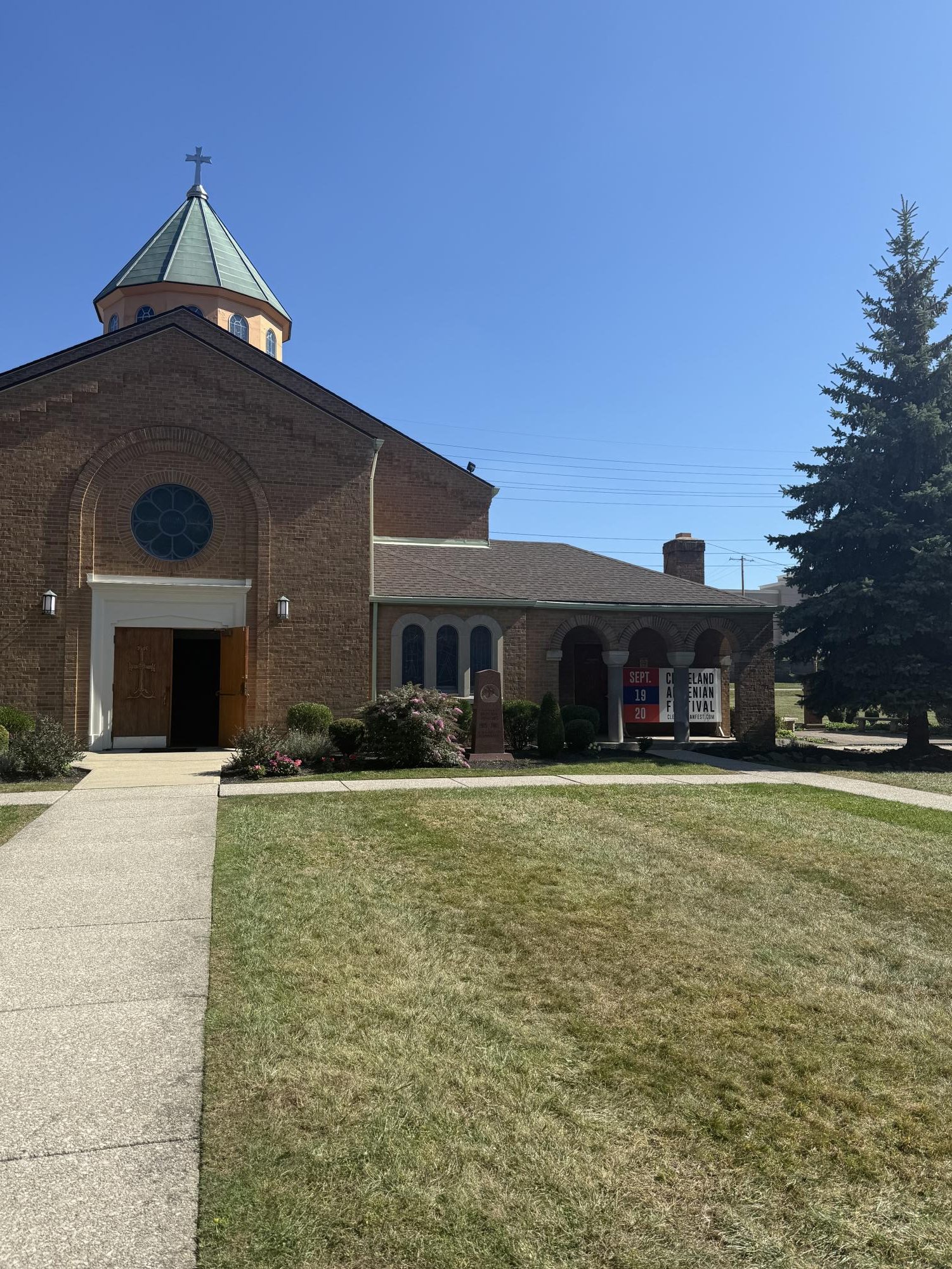
The heart of Cleveland’s Armenian community is at Saint Gregory of Narek Armenian Apostolic Church in Richmond Heights. Founded in 1911, Saint Gregory of Narek was the first Armenian Apostolic Church in Ohio.
The church houses a memorial to the 1915 genocide, dedicated in 1965.
The Polish-Jewish jurist Raphael Lemkin developed the term ‘genocide’ in part to describe and condemn the atrocities committed against the Armenian people, but the Turkish government refused to recognize that it had happened, and it was more than a century later, in 2021, when President Biden issued a statement acknowledging the atrocity of the Armenian genocide. He was the first American president to formally recognize the Armenian Genocide.
The Armenian people, who were targeted in the Armenian Highlands by the Ottoman Turks 100 years ago, resulting in the entire region’s population being exterminated, were forced to experience another atrocity in 2023, when Azerbaijani forces invaded and began an ethnic cleansing of the Armenian population in Nagorno-Karabakh, a region that had previously been majority Armenian.
Over 120,000 Armenian Christians, whose roots stretch back over 2 millennia, were ethnically cleansed from their ancestral homes. In the aftermath of the Second Nagorno-Karabakh War, both sides signed a ceasefire to end hostility and allow civilians to rebuild.
However, in Azerbaijan’s 2023 lighting offensive, Azerbaijan violated the 2020 Ceasefire Agreement, dissolved the OSCE Minsk Group (an international commission tasked with resolving the conflict), violated both the Hague Convention and Geneva Convention; meanwhile, neither the West nor Russia has taken any action to stop them.
Furthermore, despite both Russia and the United States’ commitment to ensuring peace in Nagorno-Karabakh through the OSCE Minsk Group and Russia’s military commitment to the defense of Armenia through CSTO, Azerbaijan experienced no repercussions for their actions.
To the horror of hundreds of thousands of refugees who were forced from their homes, Azerbaijan has begun the process of systematically destroying Armenian villages and buildings across Nagorno-Karabakh, despite promises of religious freedom in the region.
Historic buildings that have stood in Nagorno Karabakh for hundreds of years have been destroyed, such as the Saint John the Baptist Church, demolished in the winter of 2023-2024.
While the sacred buildings of a community thousands of years old now lie in rubble, the new Azerbaijani government has erected a park displaying dead Armenian soldiers’ equipment and wax mannequins of deceased Armenian soldiers.
Not content with disintegrating a culture and ethnically cleansing a population that once made up 99% of the population of Nagorno Karabakh, the Azerbaijan authorities now seek to publicly humiliate the deceased.
Now, Armenians in the Diaspora, including our local Cleveland Armenian Community, have to relive the horrific atrocities that their ancestors suffered once more, while the international community has looked the other way.
To understand the ongoing suffering of the Armenian community, I met with Rev. Fr. Hratch Sargsyan and local Armenian community leader Ara Bagdasarian at the Armenian Apostolic Church of Saint Gregory Narak.
Both the American and Armenian flags flew outside of the church. Entering the Church I saw the memorial to the Armenian Genocide to my left, and to my right was a community building, where the community was having lunch after their liturgical mass ended.
I sat down with the two leaders at the heart of our local Armenian community, and we spoke about the history of Armenians in Artsakh, the recent war and the silence of the international community that allowed another atrocity to unfold.
“Artsakh—or Nagorno-Karabakh—has always been Armenian land,” Sargsyan said. “There’s so much historical evidence of that. But ever since 2020, Azerbaijan has been trying to erase every trace of its Armenian presence—and no matter what they do, they can’t.”
Nagorno-Karabakh has been populated by Armenians dating back to the 2nd millennium BC, with Artsakh being mentioned as a province of the ancient Kingdom of Armenia in Urartian inscriptions.
However, Bagdasarian states the dispute over the territory stretches to the Soviet era.
“Stalin’s arbitrary decision to assign Nagorno-Karabakh to Soviet Azerbaijan forced the Armenian Christian majority to live under a government that still does not really tolerate Christians,” he said.
The collapse of the Soviet Union offered a glimpse of hope for the Armenian population in Nagorno-Karabakh, who made it clear to the Azerbaijani government that they intended to govern themselves after Baku stripped their autonomy.
In response to the loss of autonomy, local leaders organized a referendum for independence on the Dec. 10, 1991, with an overwhelming 99% majority of the population voting for independence.
Azerbaijan declared the referendum void and null, rapidly igniting tensions as Azerbaijan began a series of pogroms against Armenians in Sumgait, leading to the beginning of the First Nagorno-Karabakh War. By the end of the war, Armenia had routed the Azerbaijani Army, securing control over all of Nagorno-Karabakh.
However, while Armenia had for the time secured its people’s liberty, protecting them from occupation by a hostile government that had continuously brutalized the population, conflict would once more be on the horizon.
By the late 2010s, Azerbaijan had significantly surpassed Armenia economically, taking advantage of its large oil fields to rapidly increase its economic capabilities and reinvesting them into a large and modernized military.
Armenia, on the other hand, had suffered a string of economic decline and political instability, paving the way for Azerbaijan to begin small-scale skirmishes along the border. Eventually, the small-scale skirmishes developed into a fully fledged war, beginning the Second Nagorno-Karabakh War.
When the war reignited in 2020, Armenia found itself vastly outmatched.
“My own brother was on the front lines,” Fr. Sargsyan said. “They were fighting for their lives, for their homes, for their land.”
By the end of the war, Armenia and Artsakh were defeated, and Artsakh lost 72% of its land, including the historical Armenian city of Shusha.
However, once more, this wouldn’t be the end of the conflict, as Azerbaijan had now significantly weakened and dislodged the Armenian forces in Nagorno-Karabakh and was prepared to fully flush them out.
On the Sept. 19, 2023, Azerbaijan breached the 2020 Trilateral Ceasefire Statement, cutting off the Lachin Corridor, the only way food can enter Artsakh, and invading the region.
Nations such as Turkey, Russia, Belarus, and Israel supported Azerbaijan throughout the 2020 and 2023 conflicts.. Israel provided 27% of Azerbaijan’s major arm imports from 2011 to 2020.
With Armenia cut off and unable to assist and its population facing starvation, Artsakh capitulated and was dissolved by Azerbaijan.
Suffering soon followed, as over 120,000 people were forcefully displaced from their ancestral homeland, leaving the entirety of Nagorno-Karabakh depopulated as a result.
This catastrophic and inhumane result scarred both the surviving Artsakh community and the Armenian people as a whole. For the Cleveland Armenian community, the silence of the international community was especially painful.
“What’s really painful for us, especially those of us living in the diaspora, is how silent the world was,” said Fr. Sargsyan. “More than 120,000 people were forced from their homes, and yet it was barely spoken about.”
Global powers such as the United States, which pride themselves on defending liberty and human rights, stayed silent.
Even Armenia’s ally, Russia, which was obliged to defend Armenia, simply watched. Azerbaijan, which has been under a dynastic dictatorship under the Aliyev dynasty, was unpunished for its crimes.
“Now we hear Azerbaijan calling us the aggressors,” Bagdasarian said. “It’s heartbreaking to see that kind of revisionism being accepted. The double standards are shocking—from Europe, from the United States. In the face of such clear injustice, we don’t see much support or even acknowledgement.”
Yet, despite such a devastating event once again impacting the Armenian community, both Sargsyan and Bagdasarian spoke with resilience and hope. Rather than capitulating to the immense despair that has now plagued the Armenian community, these men continue to educate others and advocate for truth.
“We hope that students like you—by doing your own research and studying independently—will come to understand what really happened in Artsakh,” Fr. Sargsyan told me. “You can be the teacher who enlightens others, who helps people see the truth of what happened.”
A century after Armenians were victims of genocide, the world once again turned its back on their suffering. Yet, despite the deafening silence the world is in, Armenians continue to speak, pray and fight for justice. Tragedies such as this don’t demand just sympathy but the ability to listen.
*Article updated Nov. 25, 2025











adam • Jan 9, 2026 at 11:54 AM
this is so cool and such an educational article wow!