
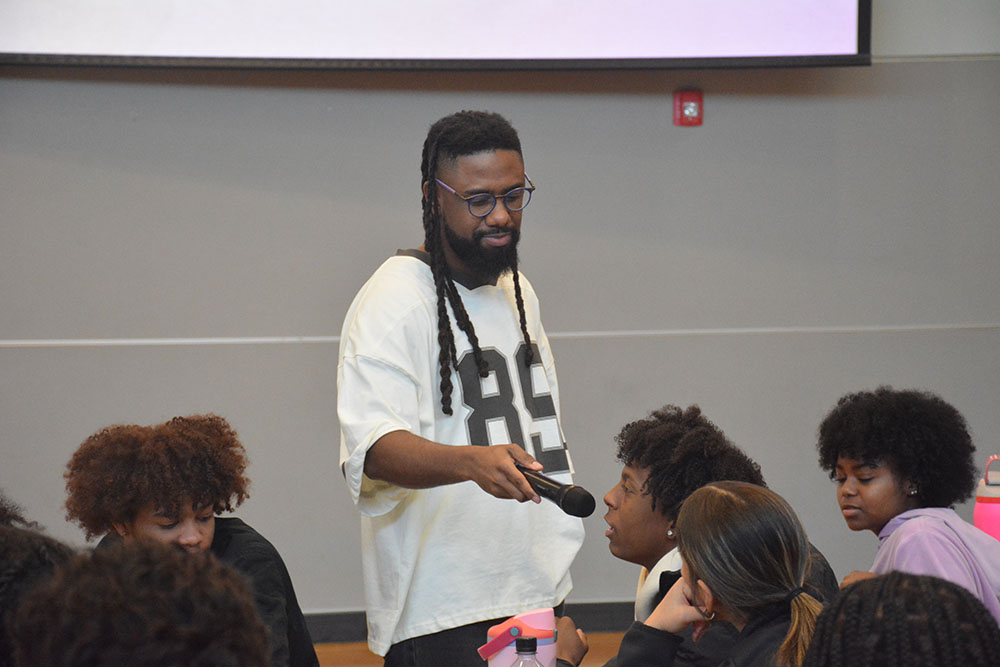
Students from AP African American Studies, African American Literature, and the MAC Scholars program gathered in the community room on Feb. 20 to hear from acclaimed author Quartez Harris.
Senior Morgan Jackson shared her appreciation for the program.
“I found the experience very engaging,” she wrote in an email. “It was nice that Mr. Quartez made himself so personable, rather than just lecturing us about all his writing.”
Jackson also appreciated Harris’ message to students that everyone can dream and achieve something bigger.
The visit, intended to connect students with contemporary voices in African American literature, offered a close-and-personal glimpse into Harris’ journey from a struggling reader to a bestselling and award winning author.
Social studies teacher Felicia Hamilton opened the program with a warm introduction, highlighting Harris’ numerous achievements: his status as a bestselling author, a celebrated poet, a dedicated Cleveland educator, father and the author of the first children’s book James Baldwin.
Harris’ work has earned numerous awards, such as the Robert F. Sibert Informational Book Award (recognizing it as one of the most distinguished informational books for children), including recognition for his contributions to children’s literature and poetry, and he has inspired countless students through his teaching and creative works.
The two-hour long program began with Harris reading from his second poetry collection, We Made It to School Alive. He spoke about his experiences as a second-grade teacher in the Glenville neighborhood with the Cleveland Metropolitan School District (CMSD), describing the neighborhood as “[where one can view the] visible sight of poverty.”
Harris’ poems reflect the challenges and triumphs of teaching in communities marked by social and economic hardship. He read several poems including So Bad to See and Butterfly, sharing the personal stories behind them, many of which were inspired by his CMSD students.
In his reading of the poem Butterfly, Harris drew on personal and tragic moments in Cleveland to highlight themes of awareness and innocence.
Tamir Rice was a 12-year-old African American boy who was fatally shot by police in Cleveland on Nov. 22, 2014. Officers responded to a 911 call reporting a “guy with a pistol” at a playground, when it was just Rice carrying a toy airsoft gun. Within moments of arriving, the officers responding to the scene shot and killed him.
For the first edition of the cover for his poetry collection, Harris explained that the inspiration for it came shortly after the Tamir Rice shooting in 2014. His son spotted a butterfly and ran to it with joy, where the butterfly did not move and appeared motionless for several minutes.
Harris used this moment to create the first edition cover of We Made it to School Alive, featuring two boys with butterfly wings.
The poetry collection also includes a poem titled Tamir in Three Parts, inspired by his story and empowered to raise awareness surrounding it.
Harris connected the reading of his poems to larger themes of awareness and growth. Harris’ teaching philosophy also came through in his poetry readings.
As an elementary school teacher, Harris was somewhat unconventional.
“[I gave my] students fifteen minutes of complete freedom in order to see their humanity,” he said. “This was a practice designed to nurture both creativity and self-awareness.”
Midway through the program, Harris shared his own personal journey as a learner and writer.
“Growing up, I never imagined becoming a writer,” he said.
Struggling with poor reading comprehension and writing expression due to a learning disability, he was supported by an Individualized Education Program (IEP).
Harris struggled with school and moved to Columbus in hopes of escaping his IEP; however, his accommodations from his IEP followed him even after his move.
Harris described a major turning point in his life, when a teacher placed him in a poetry class.
He described himself as having learned how to “play with language through poetry.”
Harris was asked about how he maintains the confidence to put his writing out in the world despite his struggles in reading and writing throughout his youth.
“I feel like [being confident, like any skill,] is something that I’m still working on,” he said. “One way I do [strengthen my confidence] is reading a lot of self-help books. I love to go to an area and just walk around and reflect on how far I’ve come and where I’m headed.”
Harris then introduced his book, Go Tell It: How James Baldwin Became a Writer, the first children’s book about James Baldwin and recipient of many prestigious awards. In addition to the Sibert award, Go Tell It became a USA Today Bestseller (indicating the book’s strong sales and popularity) and gained many more recognitions.
James Baldwin (1924-1987) was a celebrated African American writer, playwright and activist whose work explored race, identity and social justice in the United States. He was known for powerful essays, novels and speeches, where he addressed the struggles and resilience of Black communities while advocating for equality and human rights.
Though mostly recognized for his adult works, Baldwin also wrote for children, using storytelling to inspire young readers and share the lessons of his life.
Harris said he chose Baldwin as a subject due to his enduring impact on literature and social thought.
Junior Ethan Henz was inspired by the effect that James Baldwin had on Harris’ life.
“One part that stood out to me was when he talked about personal superheroes and explained that James Baldwin was his hero and a major inspiration in his life,” he wrote. “It was powerful to hear how Baldwin’s words and courage influenced him and shaped his path.”
Baldwin, as Harris noted in a Literary Hub essay, also wrote for children, tackling real-life experiences in Harlem that many young readers could relate to.
“In Little Man, Little Man, Baldwin chronicled the same themes he tackled in his adult work, blazing the way for adults to explore difficult realities through the clear-eyed view of a child,” Harris wrote in the essay.
Harris explains why he chose to write a picture book about James Baldwin instead of a traditional adult-oriented book.
“Because I was a former second grade teacher, picture book biographies are an introduction to luminaries,” he said. “Kids are very curious; we can make the most of their curiosity when [they’re still open-minded]. Every picture book biography has a background, [whether that be figuratively or literally,] and it gives [kids] a fuller account of what they’re reading.”
Harris explained his process of researching and writing the book.
“I did more research than writing,” he said. “I read over 20 books, [with] a beautiful mix of essays, poems, and works of fiction. I went to New York [where he stayed for a long time, for inspiration].
In the final part of the program, Harris engaged in a Q&A session with the students.
A student asked Harris how he manages to never run out of inspiration.
“I’m a curious person,” he said. “One, I like to ask a lot of questions. I [always] find a lot of inspiration from my questions being answered. First comes the world, then comes literature. So, a lot of the inspiration [I need] is [already] all around me.”
Another student asked about how Harris overcomes and deals with “writer’s block.”
“Writer’s block can be writer’s fear… being afraid that [what you’re writing] isn’t gonna be good enough,” he said. “The more you read the more you write well. I immerse myself in literature… with 90% of my time being reading and the rest [spent in] writing.”
Henz emphasized how he drew inspiration from Harris’ attitude towards tackling problems.
“What stuck with me most was his message about improving the skills we may not be naturally good at instead of avoiding them,” he wrote. “That idea made me think differently about various challenges, whether academic or personal and how growth comes from effort.”