
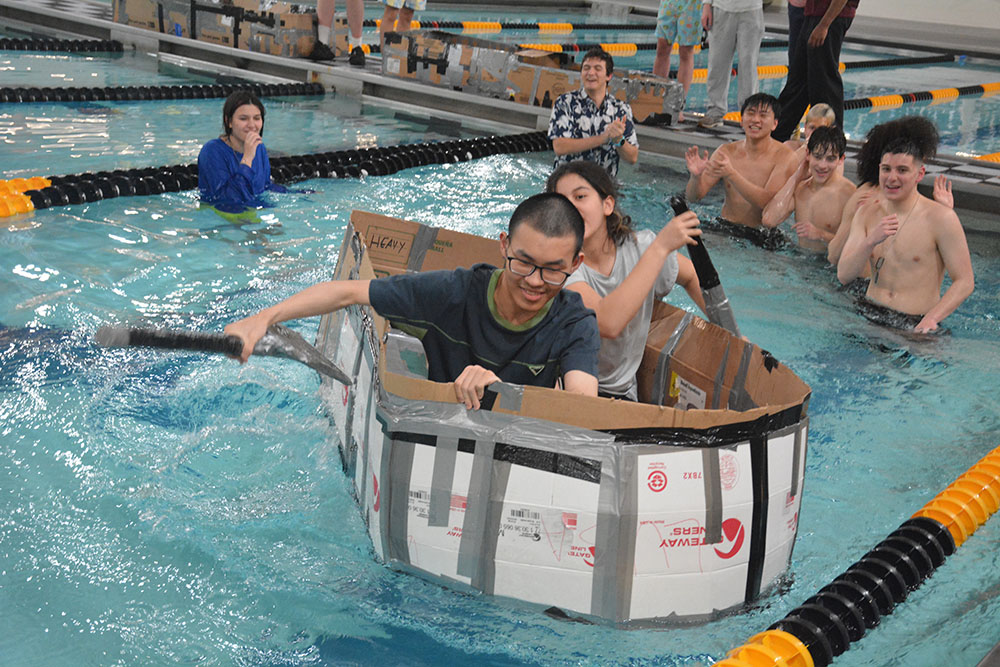
Engineering and design students participated in a duct tape and cardboard boat race in the high school pool on the afternoon of March 5.
The event challenged them to apply the skills learned in their classes.
“[The goal of the race is] to help students develop engineering problem-solving skills, as well as design and building,” design teacher Brian Hill said. “ It uses the design process, plus it’s really fun.”
Teams of students were tasked with designing and building boats made of only cardboard and tape that could float and be raced in a pool.
The winning team was made up of Sean Holdbrook-Smith, Adrian Cintron Perez, Asher Adler and Nao Okamoto.
Their ability to work together effectively and create a well-built, functional boat ultimately set them apart from the other groups. Their boat traveled across the 25 meter pool and returned in the fastest time.
“They had a really good design, great paddles and they performed best as a team,” Hill said.
One of the first challenges for the students was finding materials to build their boats.
“We kind of just ran around the school collecting cardboard,” Okamoto said. “The lunch ladies gave us many pieces of cardboard and the custodians gave us some large pieces of cardboard as well.”
Noah Beilstein found cardboard from his former employer L.L. Bean at Legacy Village.
Each team had its own approach to designing their boats. Okamoto, who had prior experience with a similar project, emphasized stability for his team’s boat.
“I did this project last year so we used a similar design,” he said. “We used a flat piece of cardboard for the base and built up the walls on the sides of the base because it is more stable than a triangle shape, especially using cardboard.”
Beilstein’s team focused on replicating real life boats.
“We tried to base it off what a real wooden boat looks like,” he said. “It had a pointed front and more rounded sides; we just wanted it to resemble an actual boat.”
Paddle design also varied between groups. Okamoto admitted his team had to improvise.
“We kind of ran out of time, so we just threw something together,” he said. “It was basically a really big paddle, and I don’t even know how it worked, but it worked.”
Beilstein’s team, however, planned theirs more deliberately.
“We tried to make them like real oars,” he said. “It worked fairly well, even though it was still cardboard.”
While building the boats was a challenge, both students highlighted different difficulties in the process.
For Okamoto, teamwork was the biggest obstacle.
“A lot of us were sick, and we kept arguing and messing around,” he said. “Honestly, I don’t even know how we ended up getting the boat secure.”
He also noted setbacks, including having to restart after their boat was sabotaged. The project took his group about three weeks to complete. Beilstein, on the other hand, said the most time-consuming part was reinforcing the structure.
“Taping all the seams took forever,” he said.
His team completed their build in about two weeks and worked together efficiently.
“We communicated a lot and split up the work,” he said.
Despite the challenges, both teams found success in the competition.
“I wasn’t expecting to win because we didn’t put a ton of thought into it, but it still worked,” Okamoto said.
Beilstein agreed.
“I think we did fairly well,” he said. “We made it all the way down and about halfway back.”
Beyond the results, both students emphasized the excitement of the event.
“It was a lot of fun,” Okamoto said. “Me and my friend dressed up and just went in trying to enjoy it.”
Beilstein shared a similar perspective.
“It was awesome, super fun,” he said. “It was cool seeing everyone else’s boats and being competitive.”
![“I’m often asked, are you glad you left the corporate world to go into teaching? [The answer is] yes," Kaminski said.](https://bcomber.org/wp-content/uploads/2026/05/DSC_6236-1200x800.jpg)